
Turning Daily Struggles into Meaningful Milestones.
From managing public meltdowns to building eye contact and first words. Our Master’s Qualified Therapists use evidence-based ABA and play-based Early Intervention to help your child learn, communicate, and thrive in their own unique way.
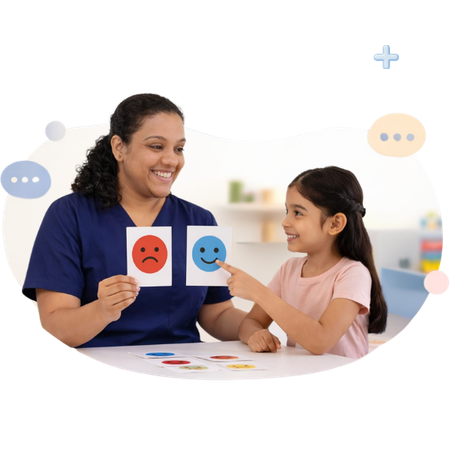
Turning Daily Struggles into Meaningful Milestones.
From managing public meltdowns to building eye contact and first words. Our Master’s Qualified Therapists use evidence-based ABA and play-based Early Intervention to help your child learn, communicate, and thrive in their own unique way.
Is Your Child Trying to Tell You Something?
The Communication Frustration
Does your child pull your hand to get what they want instead of pointing or speaking?
The Overwhelming Meltdowns
Are sudden, intense meltdowns making it hard to go to the park, the mall, or family gatherings?
The Social Disconnect
Does your child prefer to play alone, avoid eye contact, or struggle to interact with children their own age?
The Routine Rigidity
Does your child get extremely upset if their daily routine or environment changes even slightly?
✨ The Reality
“Bad behavior” is often just a child’s way of communicating that they are overwhelmed or lack the skills to express their needs. We are here to build those missing skills.
Evidence-Based Care for Autism & Developmental Delays
We use globally recognized therapies to build independence and reduce frustration.
Core Behavioral Interventions
-
Applied Behaviour Analysis (ABA) The gold-standard, structured therapy to improve learning, build communication, and gently reduce challenging behaviors using positive reinforcement.
-
Behavior Modification Programs We don't "punish." We use scientific techniques to help your child replace unwanted behaviors (like hitting or throwing) with functional, healthy alternatives.
Early Intervention & Play (Ages 0-5)
-
ESDM-Based Early Training (Early Start Denver Model). A highly effective, play-based intervention for toddlers. We use fun routines to naturally build engagement, joint attention, and developmental milestones.
-
Social Skills Training We teach the "unwritten rules" of play—building essential skills like turn-taking, maintaining eye contact, sharing, and peer interaction.
Communication & Family Empowerment
-
Functional Communication If a child can't speak yet, we reduce their frustration by teaching them to communicate using gestures, picture cards (PECS), or AAC devices.
-
Parent Coaching Programs Therapy doesn't end when you leave the clinic. We guide you with practical, home-based strategies to manage behaviors and make daily routines (like bedtime or mealtime) peaceful again.
Why Your Therapist’s Qualifications Matter in ABA
Behavioral therapy requires deep psychological and developmental understanding. Doing it wrong can actually increase a child’s anxiety. At Oasis, your child is strictly treated by Master’s Qualified Professionals trained in Autism care and behavioral sciences.
Play-Based, Not Robotic
We believe ABA should be fun. We integrate therapy into natural play so your child enjoys coming to the clinic.
Individualized Goals (ITP)
We don't use cookie-cutter programs. Whether the goal is "toilet training" or "speaking in sentences," the plan is built around your child.
Family-First Focus
We view parents as our co-therapists. You will never be left in the dark about your child’s progress.
Your Journey to a Calmer, Happier Home
Frequently Asked Questions
Clear answers from Gujarat’s most qualified rehabilitation team.
At what age should we start Early Intervention?
As early as possible! Research shows that interventions starting before age 3 (during peak brain plasticity) yield the most dramatic improvements in IQ, language, and social skills. If you notice red flags, do not “wait and watch.”
I heard ABA is too strict or "robotic." Is that true?
Older versions of ABA were sometimes rigid, but modern ABA (like what we practice at Oasis) is heavily play-based and child-led. We focus on positive reinforcement and building a warm, trusting bond with your child.
Will my child have to do this forever?
No. The goal of our behavioral therapy is to build independent skills and “graduate” your child. As they learn to communicate effectively, challenging behaviors naturally decrease, and therapy hours can be reduced.